
I fortunately came across Dr. Mesut while researching orthopedic surgeons in Antalya after suffering a severe heel fracture in the United States. From the beginning, I was uneasy with the treatment plan proposed by my U.S. surgeon. After more than a year of being told that it was simply a “bad break” that would take time to heal, it was finally discovered that I had also severely sprained my ankle at the time of the injury, resulting in partial ligament and tendon tears that had been missed entirely. When these tears were eventually identified, the solution I was given was ankle fusion surgery, an option that would have permanently limited my mobility. This did not sit right with me. While in Antalya for my spouse's dental care, I had the opportunity to consult with Dr. Mesut at MSM Klinik. His team quickly arranged comprehensive testing to fully understand what was happening with my foot. Dr. Mesut confirmed the ligament and tendon damage but was very clear that ankle fusion was not the appropriate solution for my case.
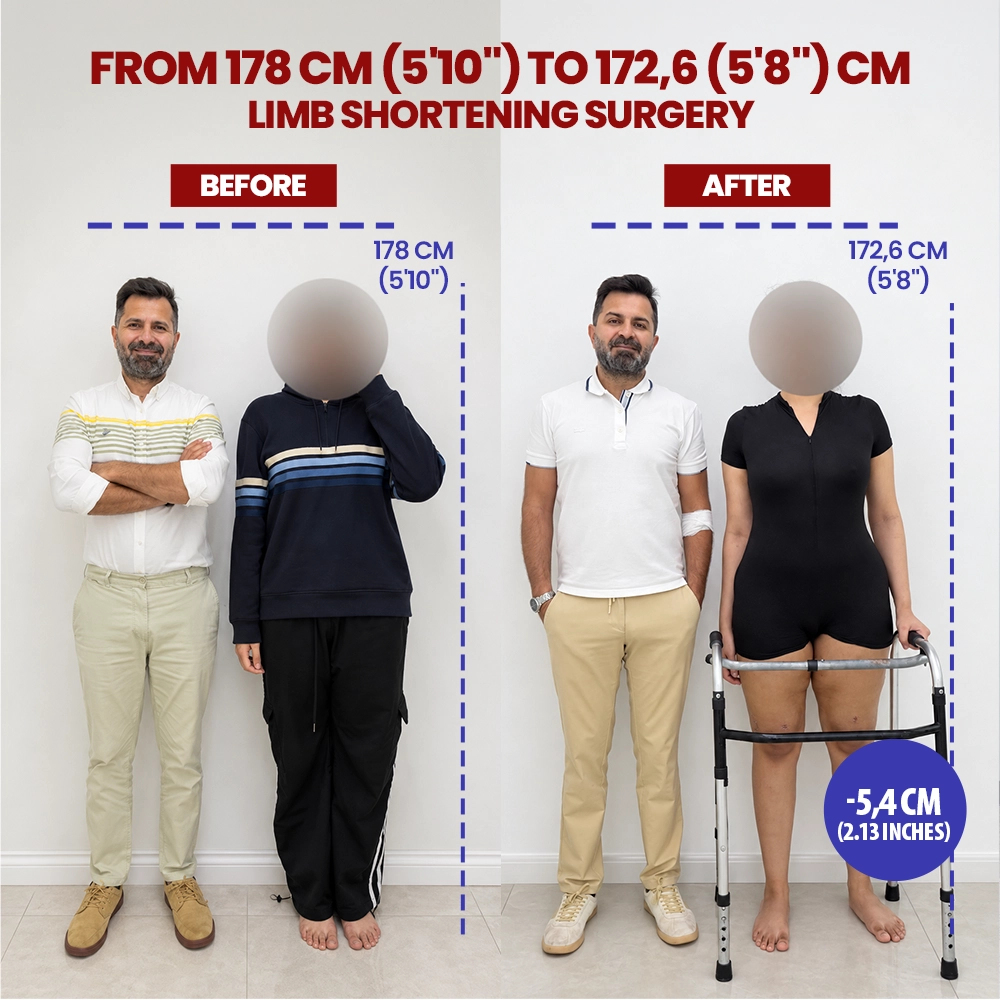
A real patient, measured
Before and after, with the actual figures
−6 cm
Before 178 cm · after 172 cm
5′10″ → 5′8″
Four centimetres from the femur, two from the tibia, both legs. Each segment has its own safe limit, so a figure this size is shared across two levels rather than forced out of one.
Results vary. What is safely achievable depends on your bone anatomy, muscle length and which segment is used, and is agreed in writing after X-ray assessment. Unretouched, standardised conditions, published with signed patient consent.
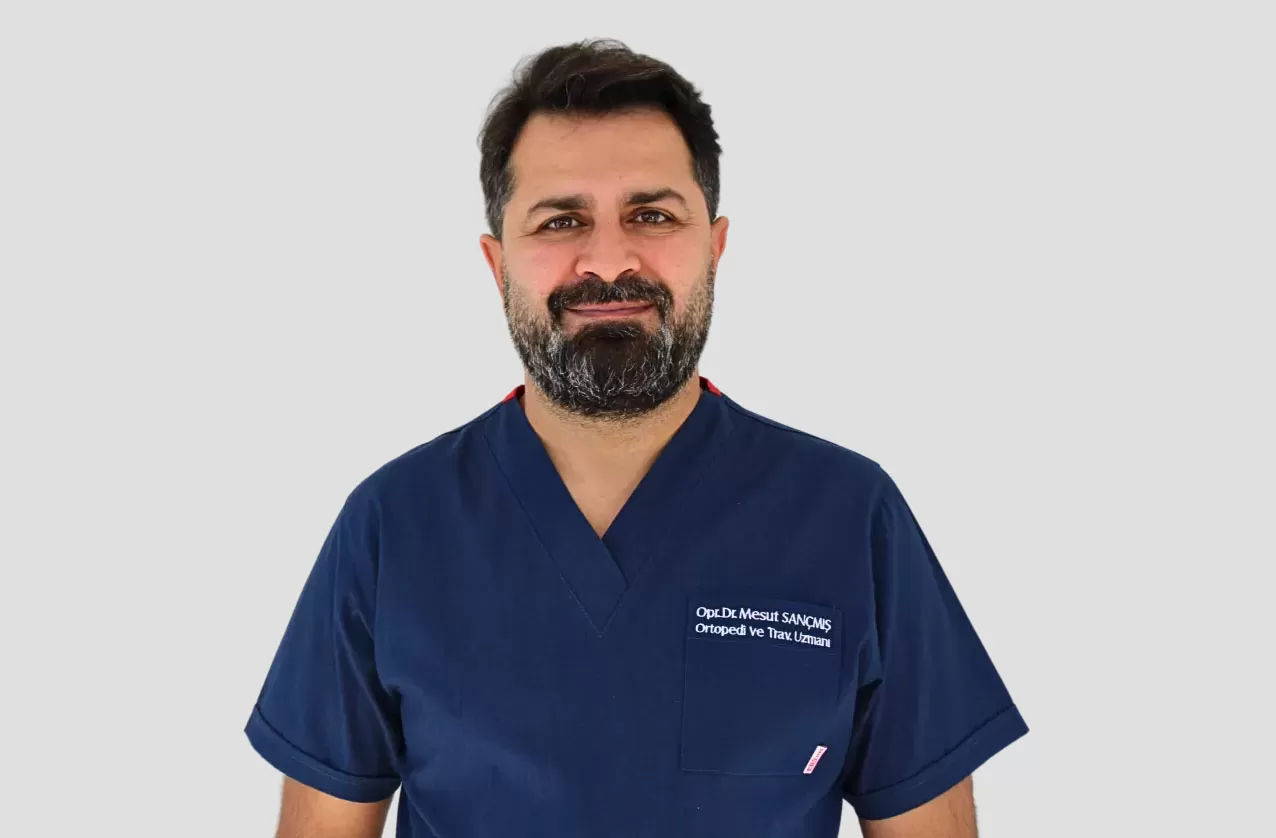
Who will actually operate on you
A surgeon who will tell you when the answer is no
17 years
in orthopaedics and traumatology,
since 2009
Removing bone from a healthy leg is a serious decision and a narrow indication. It is the right operation for a genuine leg length difference, and it is occasionally the right operation for extreme height — but it is the wrong operation far more often than clinics advertising it admit. Op. Dr. Mesut Sançmış trained and practised at Akdeniz University Faculty of Medicine, spent six years as a consultant in Turkish state hospitals, and founded MSM Clinic in 2022.
Every cosmetic enquiry is assessed clinically and psychologically before it is accepted. If your proportions are within normal range, or if what is driving the request would not be solved by four centimetres, we will tell you so and decline the case.
◆Orthopaedics & Traumatology specialist◆In orthopaedics since 2009 · specialist since 2015◆Osteotomy · limb reconstruction · deformity correction◆Faculty member, Alanya University, since 2024◆Peer-reviewed publications in orthopaedic journals◆Ministry of Health health tourism authorisation
Independently verified
Patient reviews — Trustpilot & Google
Reviews from across the practice — knee, foot and ankle, trauma and deformity work. This is the surgeon’s day job, not a sideline.
My wife had a knee injection at MSM Klinik in Antalya in Turkey last year. She had been suffering from severe knee pain for several years and the injection really helped her regain mobility. So, we returned to MSM Klinik this year, where she has now had a second injection, which we expect will help her sustain her ability to walk at least another six months free of pain. My wife has been referred to NHS orthopedic specialists in the UK and is waiting for their diagnosis also. Waiting times are very long still in the UK, so the assistance provided by MSM Klinik in Turkey in the meantime has been extremely helpful.
I would like to express my sincere gratitude to Dr. Mesut and the staff of Rabia and Delsad hospitals, who promptly and professionally assisted in removing cysts on the index finger of my left hand. I flew to Antalya from London, where I was examined for 5 months. 2 MRI scans, 2 x-rays and 1 ultrasound were performed. So without waiting for help, I turned to the MSM clinic. During the day, Dr. Mesut took an X-ray examination and operated on it. I am very grateful to the doctor for his responsiveness and professionalism, as well as his team. I wish your clinic prosperity. I recommend it.
Service was excellent. I'm forever grateful to Surgeon Mesut Sancmis for taking care of me. I'm still recovering and have a follow up coming soon but I'm confident I will recover 100%. The whole staff was very attentive and professional. Starting with the driver, he was so helpful and nice assisting me with my wheelchair. Amy, who was with me throughout the whole process, made sure all my needs and concerns were addressed. I didn't feel there was a language barrier because she was there to translate and facilitate all my needs. Even after discharge Dr Mesut and Amy visited me multiple times to check on me and make sure everything was going well. I highly recommend them.
Dr Mesut and the team were exceptional and delivered excellent service. My issue was well investigated and management options and plans were provided. I am well satisfied with the service and happy with the outcome. Thank you again.
Superb service and very quick and professional, made me feel at ease, reassured me every step of the way. If you need pain blocking or facet joint injections then come here, they will solve your problem. From the minute I arrived I knew I had chosen the best surgeon and team to help me. I had an MRI and x-ray within an hour of my consultation, 2 hours later I had a full diagnosis and treatment plan, 20 minutes after that I had my treatment. They've taken away my pain and I'm so happy. I will return if I ever need help in the future, 100%.
I wish to take this opportunity to thank Dr Mesut Sançmış for his kind, caring and professional approach to my long term medical issues. He very efficiently examined, tested and diagnosed my medical issues and offered treatment of arthroscopic knee surgery for the following day. The surgery was an absolute success with my original pain now gone and the procedure stiffness subsiding daily. I can already walk and sleep better and my quality of life is improving. The constant pain etched on my face and in my daily life has gone and I can never thank him enough. He is a true gentleman and 5 star surgeon.
From the very beginning, I felt that I was in good hands with Dr. Mesut Sançmış. The consultation was clear, supportive and reassuring, which made me feel confident about moving forward. Throughout the treatment, Dr. Mesut Sançmış showed great care and professionalism, always making sure I was comfortable and informed. The results have exceeded my expectations — my feet not only look better, but I feel more confident and at ease in my daily life. It has truly been a positive change for me, both physically and emotionally. I am very grateful for the expertise, kindness and attention to detail. I would gladly recommend this clinic to anyone looking for high-quality, compassionate care.
MSM Klinik have been excellent. From the initial consultation, through the hospital procedure and the after care — absolutely fantastic. Communication about the knee procedure and the ease of making it happen, with genuine concern for your welfare and recovery. Highly recommend this great clinic. Thanks MSM.
Top orthopedic. We needed a hand surgeon for our son who had an accident with a knife. Great service via WhatsApp, they speak English. Modern clinic, all innovative methods, state of the art equipment. Near hotels in Lara and Kundu. Also good for international tourists.
I had a really painful neck and back. I had two therapy sessions and it really, really helped. I now don't feel pain and the movement in my back is so much better. Thank you!
Challenging or mild conditions require the type of specific attention provided. Dr. Mesut Sançmış and his entire staff are highly knowledgeable and solution focused. It is incredible to witness the difference their patient care delivers. Do you have back pain, shoulder issues, orthopedic problems? Here's your source for these and much more. Please don't hesitate to book your first consultation to start on the path of healing.
What is actually removed, and from where
How a limb is shortened
A measured segment of bone is removed, the two ends are brought together and held with a nail inside the bone until they heal as one. There is no lengthening phase and no external frame, which is why recovery is considerably shorter than for lengthening. The limit is not the bone — it is how much slack the muscle around it can absorb.
Femoral shortening
4–5 cm
A measured segment is removed from each thigh bone and the ends fixed with an internal nail. The femur tolerates the largest reduction, which is why it is almost always the segment used.
Tibial shortening
2–3 cm
Less is possible in the shin than in the thigh, because the calf muscles and the nerve have far less slack. Used on its own for a small reduction, or added to the femur for more.
One leg only
To match, exactly
The most common reason for this operation: shortening a longer leg so both match. The target is not a preference, it is a measurement — and it removes the lift, the limp and the back pain with it.
Assessment before you fly
Full-length standing X-rays of both legs, a true measurement of any length difference, and a review of what you are actually trying to change. Cosmetic cases also go through a psychological assessment at this stage, not after you have paid.
From home · 2–4 weeks
Planning the resection
The exact segment to be removed is measured on your imaging — how much, from which bone, at which level. Nail length and diameter are chosen in advance. The number is agreed with you in writing before you travel.
Before surgery
Surgery
The planned segment is removed, the bone ends are brought together and held with an intramedullary nail. One to two hours per leg. Both legs in the same session where the plan is bilateral.
Antalya · day 0
First two weeks
Two to three nights as an inpatient, then walking with crutches. Physiotherapy starts immediately and is aimed squarely at the quadriceps, because the muscle is now longer than the bone it works over.
Antalya · weeks 1–3
Bone union
The two bone ends heal together. There is no lengthening phase, so this is the whole of the bone-healing work. Weight is increased on X-ray evidence, with most patients off crutches between weeks six and ten.
Home · weeks 3–12
Muscle strength
The longest part of this recovery is not the bone, it is getting full extensor power back. Structured strengthening for four to six months, with gym and running cleared once union is confirmed.
Home · months 3–9
The part most clinics leave out
Cutting healthy bone to reduce height is a narrow indication, and among orthopaedic surgeons it is a contested one. We think that is the right starting point rather than something to hide. Below are the risks that matter in shortening specifically — they are not the same as the risks of lengthening — and what we do about each.
- Muscle weakness and extensor lag the characteristic complication of shortening Removing bone leaves the muscle longer than it needs to be, and slack muscle is weak muscle. It is why the safe limit exists, and why quadriceps work starts on day one rather than week six. It is also why we will not exceed the planned figure to please you.
- Delayed union or non-union ~5–10% of osteotomies Rigid intramedullary fixation, compression across the bone ends, and staged weight-bearing checked on X-ray rather than by feel. Smoking is the single biggest factor, which is why we ask you to stop.
- Nerve or vessel injury uncommon, more likely in the tibia This is why the tibia takes a smaller reduction than the femur: the nerve and the vessels have far less slack in the calf. Where a larger figure is wanted, it is taken from the femur.
- Infection ~1–3% with internal fixation Internal nails carry a much lower infection risk than external frames. Antibiotic protocol and wound review at every visit during the Antalya phase.
- Altered proportions a real and permanent trade-off Shortening the legs makes the torso proportionally longer. Sitting height does not change. For most people at 195 cm and above this is barely visible, but it is discussed and shown to you before consent — not discovered afterwards.
- Regret the risk nobody prices in A cosmetic reduction is permanent and cannot be reversed. This is the reason for the psychological assessment, and the reason we decline cases where height is standing in for something else.
Rates are drawn from published series on shortening osteotomy and vary by segment, by the size of the resection and by centre. Reported outcomes cluster around reductions of four to five centimetres, which is the range within which function is reliably preserved. Your individual risk is discussed with the surgeon before consent, not after.
For international patients
Our international guest services
You will be in Antalya for three to four months on crutches. Everything below exists to make that period ordinary rather than difficult.

You land, we take it from there
Antalya has direct flights from more than twenty UK and European cities, so there is no connection to manage on crutches. Every transfer during your stay is arranged for you.
- Private airport transfer, wheelchair-accessible vehicles
- Door-to-door transport for every clinic and physiotherapy appointment
- Flight guidance from your nearest airport
- Fit-to-fly assessment before you travel home

A flat you can actually live in for four months
A hotel room is fine for a week and miserable for a season. We arrange step-free apartments minutes from the clinic, with a kitchen, a lift and space for a walker.
- Step-free apartments with lift access, within walking distance
- Bathroom adapted for the fixator phase
- Room for a partner or family member to stay
- Hotel option available if you prefer serviced

Everything in English, in writing
One named coordinator from your first message to your final review, and every clinical instruction given to you in writing so nothing depends on remembering a conversation.
- One dedicated coordinator, not a rotating inbox
- Interpreter present at every clinical appointment
- Written plans, protocols and discharge notes in plain English
- WhatsApp support seven days a week

Care that follows you home
Most of your recovery happens in your own country. This is the part to interrogate before you choose any clinic, anywhere.
- Fortnightly remote X-ray review by your surgeon, in writing
- Full handover pack for your GP or local orthopaedic team, in English
- Named contact with a defined response time, not a general inbox
- Complication cover — what is included and for how long, given to you in writing before you pay
One figure, agreed before you commit
Your quotation is issued in your own currency and includes the removal surgery. What you are quoted is what you pay.
- Written quotation before any deposit
- Fixator and nail removal surgery included, not billed later
- Exclusions listed in the same document as the inclusions
- Staged payment on request
Find out whether this is the right operation for you
Send your height, what you are trying to change and your X-rays if you have them. Dr. Sançmış reviews every enquiry himself and replies with whether the operation is indicated, what is safely achievable and a written quotation — usually within four hours.
Transparent pricing
What is included, and what the difference actually pays for
Your figure is confirmed after X-ray assessment and issued in writing, all-inclusive, with the exclusions listed in the same document — before you are asked for anything.
United Kingdom · United States
Private self-pay- ✕ Among the most expensive markets in the world for this operation
- ✕ Very few surgeons offer shortening for a non-medical indication at all
- ✕ Not funded where the indication is appearance rather than function
- ✕ One leg per admission is common, so two operations and two recoveries
- ✕ Nail removal quoted separately
MSM Clinic · Antalya
All-inclusive, confirmed after assessment- ✓ Both legs in one operation where the plan is bilateral
- ✓ Full-length imaging, planning and all control X-rays included
- ✓ Physiotherapy throughout the Antalya phase, included
- ✓ Implants, hospital stay and transfers included
- ✓ Written quotation before any deposit — the quote is what you pay
Every package covers surgery, implants, hospital stay, pre-operative testing, full-length imaging and all control X-rays, physiotherapy during the Antalya phase and transfers. Flights, accommodation beyond the standard allowance, a companion's costs and imaging in your home country are not included and are listed as exclusions in your written quotation. Your figure is confirmed after X-ray assessment and issued in writing.
Answered properly
The questions everyone asks
Four to five centimetres from the femur, two to three from the tibia. Both segments together can reach seven or eight, but that is a much bigger undertaking and it is not what most people need.
The limit is muscle, not bone. Take too much and the muscle around it is left slack, which means weak. Anyone offering you a dramatic reduction is offering you a weak leg.
In principle, yes. In practice the recovery is considerably shorter, because there is no distraction phase — no daily lengthening, no external frame, no three to four months of waiting for new bone to form. The bone ends are brought together and simply heal.
What shortening has that lengthening does not is the muscle problem: after lengthening the muscle is stretched tight, after shortening it is left slack.
For a leg length difference, shortening the longer leg is usually simpler, quicker and lower risk than lengthening the shorter one. Lengthening means months of distraction; shortening is one operation and a heal.
The exception is where you cannot afford to lose the overall height, or where the difference is very large. That is a conversation with the X-rays in front of you.
Two to three weeks. Two to three nights as an inpatient, then wound checks, physiotherapy and a control X-ray before you are cleared to fly. The rest of the recovery happens at home.
Walking with crutches from the day after surgery. Most patients are off crutches between weeks six and ten, on X-ray evidence rather than on how the leg feels. Driving usually returns around week eight, a desk job from week three to four.
Full strength takes longer — four to six months of structured quadriceps work.
Temporarily, yes. That is the honest answer and it is the defining feature of this operation. Removing bone leaves the muscle longer than the lever it works over, and it takes months of targeted strengthening to recover full extensor power.
Within the safe range, function returns. Beyond it, it may not — which is why the safe range exists.
Your torso becomes proportionally longer, because your sitting height does not change. At the heights where this operation is usually indicated the effect is barely visible, but it is permanent and it is shown to you on your own measurements before you consent.
For a cosmetic reduction, yes, and it is not a formality. This is permanent, it cannot be reversed, and distress about height is frequently standing in for something a surgeon cannot fix.
If the assessment suggests surgery is not the answer, we decline the case. We would rather lose an enquiry than remove bone from someone it will not help.
Yes. Nail insertion needs a small incision, usually near the hip or the knee depending on the segment. They are shorter than the incisions used in plate fixation, but they do not disappear.
Not necessarily. Many patients leave them in permanently. Removal is a short second procedure and is usually considered after twelve to eighteen months if the nail becomes uncomfortable. Whether it is included is stated explicitly in your written quotation.
Skeletal growth must be complete, so eighteen at the earliest. There is no strict upper limit, but bone healing slows with age and each case past about fifty is assessed individually.
We do not accept patients under eighteen for cosmetic reduction under any circumstances.
You get a named contact with a defined response time, and your imaging is reviewed by the surgeon who operated. Your GP or local orthopaedic team receives a full handover pack in English — operative notes, implant details, imaging and protocol.
What is covered financially, and for how long, is set out in writing in your treatment agreement before you pay a deposit. Ask every clinic you are considering for that document.
From enquiry to Antalya
A simple three-step start
Send your details
Your height, what you are trying to change, and X-rays if you already have them. If not, we tell you exactly which views to ask for at your local imaging centre.
Assessment
A video consultation with Dr. Sançmış, and for cosmetic cases a psychological assessment. You leave knowing whether the operation is indicated, what is safely achievable and a written quotation.
Travel to Antalya
Flights, transfers, accommodation and your physiotherapy schedule are arranged before you land. Two to three weeks here, then the rest of the recovery happens at home.
Why Antalya
Recover in Antalya, on the Mediterranean coast
A look at Antalya and the clinic, before you decide.
- Sea, sun and a flat seafrontA level coastal promenade to walk on, in one of the warmest cities in the Mediterranean.
- Everything ten minutes awayClinic, physiotherapy and your apartment within the same few streets. No commute on crutches.
- A short stay, not a long oneTwo to three weeks here. Most of the recovery happens at home, with remote X-ray review.
- Direct flightsAntalya (AYT) connects directly to more than twenty UK and European cities.